
Lighting Guides
High Bay Lights: Why Tall Spaces Need Different Lighting
Learn why high bay lights are used in warehouses, factories, logistics hubs and other tall spaces, and how they support visibility, safety and efficiency.
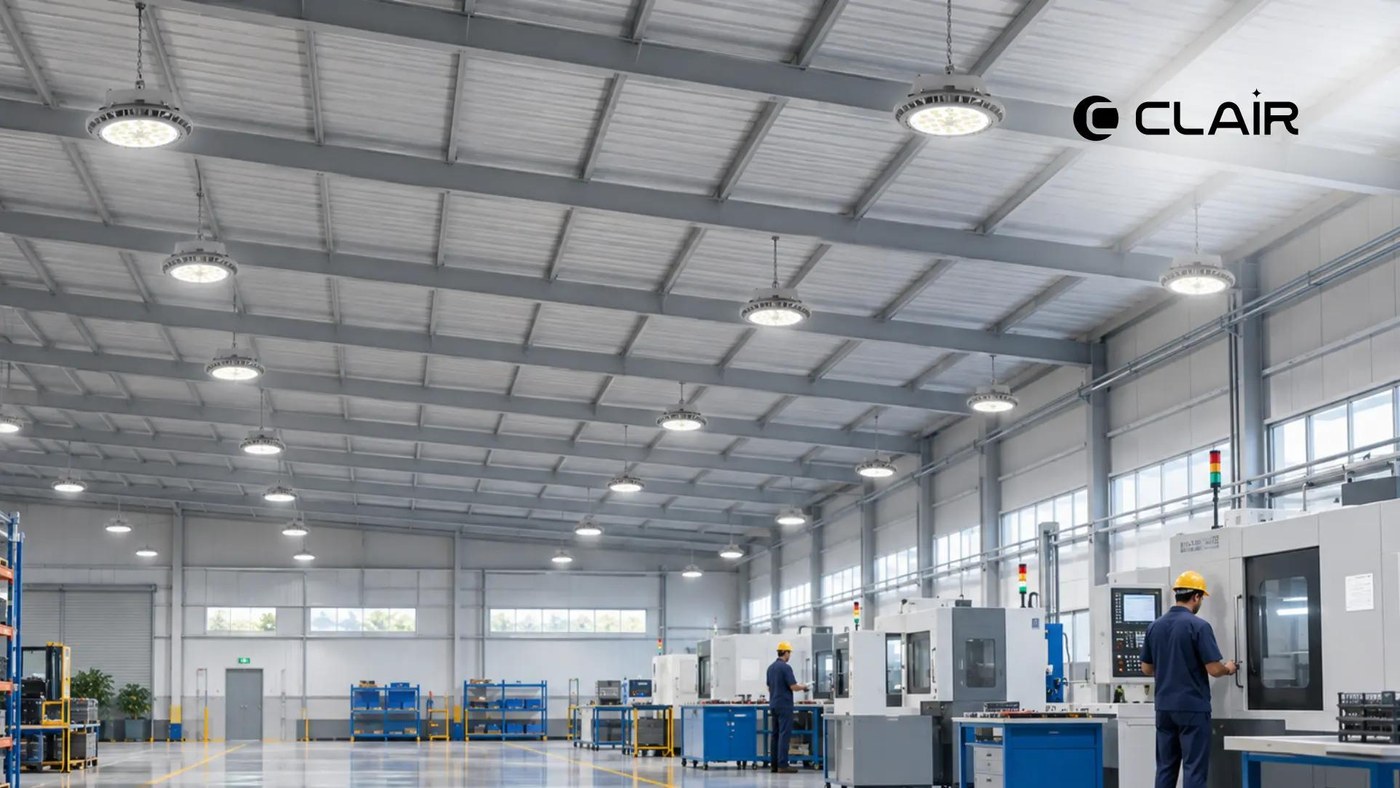
Why tall spaces need a different lighting approach
High bay lights are designed for spaces where regular lighting is not enough. Warehouses, factories, logistics hubs, production floors, large retail stores and industrial sheds often have high ceilings, wide floor areas and demanding visibility needs.
In these spaces, the challenge is not just to make the area bright. The real challenge is to make light reach the working plane clearly, evenly and efficiently.
A light installed at a high mounting point has to travel further before it reaches the floor, racks, machinery, aisles or workstations. If the fixture is not designed for that height, the result can be poor visibility, dark patches, glare, energy waste and uncomfortable working conditions.
That is why tall spaces need high bay lighting.
At Clair, we look at high bay lights as performance products for large spaces. They need to support visibility, safety, efficiency and long-term reliability.
Explore Clair’s LED high bay lights for warehouses, factories and industrial spaces.
What are high bay lights?
High bay lights are lighting fixtures used in spaces with higher ceilings and larger open areas. They are commonly used in warehouses, factories, manufacturing units, logistics hubs, sports facilities, industrial sheds and large commercial spaces.
The U.S. Department of Energy notes that high bay and low bay fixtures are commonly used in commercial and industrial buildings that need high light output and long operating hours.
The purpose of a high bay light is simple: deliver useful illumination from a higher mounting height to the area where people actually work, move or operate equipment.
This is where high bay lights differ from regular indoor lights. They need stronger output, better optics, suitable beam distribution and durable construction for industrial environments.
Brightness alone is not enough
A tall space can have powerful lights and still be poorly lit.
If the beam is too narrow, some areas may become too bright while others remain dark. If the beam is too wide, light may spread too much before reaching the floor. If glare is not controlled, workers may experience visual discomfort. If the layout is wrong, aisles, racks or task areas may not get enough usable light.
The latest ISO/CIE workplace lighting standard focuses on visual comfort, visual performance and safety for indoor workplaces. This matters because industrial lighting is not only about visibility. It is also about how comfortably and safely people can perform visual tasks.
For high bay applications, the right lighting plan should consider:
Mounting height
Beam angle
Light output
Spacing between fixtures
Rack and machinery layout
Glare control
Colour rendering
Driver quality
Maintenance access
Energy efficiency
In short, high bay lighting should be planned around the space, not just the wattage.
Where high bay lights are used
High bay lights are useful in spaces where ceiling height and floor area create lighting challenges.
Warehouses need visibility across aisles, racks, picking zones, packing areas and loading sections.
Factories need uniform illumination for machinery, production tasks, inspection areas and worker movement.
Logistics hubs need clear visibility for sorting, storage, vehicle movement and dispatch operations.
Industrial sheds need durable lighting that can support long operating hours.
Large retail and wholesale spaces need bright but comfortable lighting for product visibility and customer movement.
Sports and multipurpose halls need lighting that can cover large areas without creating harsh shadows.
Each space has a different requirement. A warehouse aisle does not need the same lighting pattern as a factory workstation. A loading dock does not need the same treatment as a high-rack storage area.
Why LED high bay lights are preferred
LED high bay lights are widely used because they offer better energy efficiency, longer life and better control compared to older lighting technologies.
For large spaces, this matters a lot. A warehouse or factory may need many fixtures operating for long hours. Even small efficiency differences can affect electricity consumption and long-term operating costs.
The U.S. Department of Energy states that high bay and low bay fixtures are among the commercial and industrial applications with major LED savings potential because these spaces require high light output and long operating hours.
LED high bay lights can also provide better optical control. This helps direct light where it is needed instead of wasting it in unused areas. With the right product and layout, LED high bay lighting can support both visibility and energy efficiency.
Glare control and worker comfort
In factories and warehouses, people often look across long distances, upward towards racks, or towards machinery and reflective surfaces. Poorly controlled glare can make the space uncomfortable even when it appears bright.
Glare can affect visibility, concentration and comfort. In industrial areas where people work for long hours, this becomes important.
The Illuminating Engineering Society’s recommended practice for industrial facilities notes that lighting features beyond the quantity of light can contribute to worker efficiency and safety, including glare, visual comfort and the relationship between the light source, task and eye position.
This is why high bay lights should not be selected only by lumen output. Optics, fixture placement and glare control also matter.
Durability matters in industrial spaces
High bay lights are often installed at significant heights. This makes maintenance more difficult than in regular spaces. Replacing a failed fixture may require ladders, lifts, shutdown planning or additional labour.
That is why durability and product quality are important.
Good high bay lights should be selected with attention to heat management, driver quality, housing strength, efficiency, warranty, IP rating where needed and long-term performance. In dusty, hot or high-use environments, the product must be suitable for the actual site condition.
A reliable fixture reduces maintenance interruptions and supports smoother operations.
Connect with Clair for high bay lighting guidance, product specifications and project enquiries.
High bay lighting should match the application
The best high bay lighting plan starts by understanding the space.
What is the ceiling height?What tasks happen below?Are there racks, machines or open areas?Do people work there for long hours?Is the space dusty, hot or exposed?Are sensors or controls needed?How easy is maintenance access?
These questions help decide the type of high bay light, output level, beam angle, layout and control strategy.
For example, a warehouse with tall racks may need a different beam pattern than an open production floor. A logistics hub may need strong coverage across movement zones. A factory may need better uniformity and colour quality in work areas.
High bay lighting works best when it is application-led.
How Clair approaches high bay lighting
At Clair, high bay lights are not treated as just another industrial product. They are part of how large spaces function.
A well-planned high bay lighting system can support safer movement, better task visibility, improved energy efficiency and reduced maintenance concerns.
With LED lighting solutions for industrial, commercial and project environments, Clair helps support warehouses, factories, logistics spaces and large facilities with lighting designed for performance and reliability.
Because tall spaces do not just need more light.
They need the right light, delivered the right way.
FAQs
1. What are high bay lights?
High bay lights are lighting fixtures used in large indoor spaces with high ceilings, such as warehouses, factories, logistics hubs and industrial sheds.
2. Where are LED high bay lights used?
LED high bay lights are used in warehouses, manufacturing units, production floors, storage facilities, sports halls, large retail spaces and industrial buildings.
3. Why are high bay lights needed for tall spaces?
Tall spaces need lights that can deliver useful illumination from a high mounting height to the floor, racks, machines and work areas.
4. Are LED high bay lights energy-efficient?
Yes. LED high bay lights are generally more energy-efficient than older lighting technologies and are suitable for spaces that require high output and long operating hours.
5. What should be checked before choosing high bay lights?
Check ceiling height, beam angle, light output, fixture spacing, glare control, colour quality, driver quality, IP rating, energy efficiency and maintenance access.
Sources
[1] ISO/CIE 8995-1:2025, Light and lighting, Lighting of work places, Part 1: Indoor.[2] CIE, Light and lighting, Lighting of work places, Part 1: Indoor.[3] Illuminating Engineering Society, Recommended Practice: Lighting Industrial Facilities.